
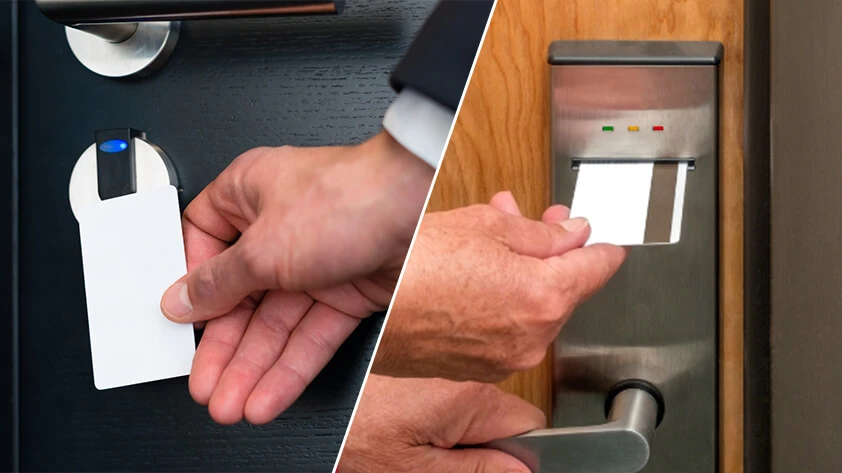
One card needs a swipe through a slot, while the other just taps near the lock and opens. Both are the same size, fit in a wallet, and carry guest access data. What makes them work so differently comes down to how each one stores, transmits, and protects that information underneath the surface.
RFID hotel key cards and magnetic stripe cards represent two generations of access technology built on completely different principles. The gap between them shows up in everything from security and durability to guest experience and what the card can actually do beyond opening a single door.
- Data Storage: Surface Stripe vs. Sealed Chip
The core difference starts with where the data lives. A magnetic stripe card keeps everything on the surface, while an RFID card buries it inside the card body, where nothing can touch it. That single distinction drives every other difference between the two.
Stripe on the Surface
A thin strip of magnetic material runs across the back of a magnetic stripe card. Iron-based particles on that strip form patterns representing guest access data, using the same basic technology behind old cassette tapes. Stripe cards come in two variants:
- LoCo (Low Coercivity): Easier to encode but easier to accidentally erase from phone or wallet contact
- HiCo (High Coercivity): More resistant to erasure but still vulnerable to strong magnetic fields
Chip Sealed Inside
RFID hotel key cards embed a tiny microchip connected to a coiled antenna inside the PVC layers. Nothing sits on the surface, and no part of the data storage is exposed to friction, scratches, or magnetic interference.
Three Frequency Bands in Use
- LF (125 kHz): Older lock systems, shorter read range, basic encryption
- HF / NFC (13.56 MHz): Modern hotel standard, strong encryption, mobile key compatible
- UHF (860-960 MHz): Longer range, emerging for multi-access across rooms, parking, and amenities
- At the Door: Swipe Contact vs Wireless Tap
The guest interaction with the door is where the two technologies feel most different, and it is also where the reliability gap becomes obvious.
A magnetic stripe card has to be swiped through a slot. The mechanical reader inside makes physical contact with the stripe and reads the data as the card passes through. That contact wears the stripe with every swipe, and dirt builds up in the slot over time. A phone stored in the same pocket can demagnetize the data before the guest even reaches the room.
An RFID card works without touching the lock at all. Held within a few centimeters, a low-power radio signal from the lock activates the card’s antenna. The chip transmits encrypted access data wirelessly, the lock verifies it, and the door opens in under a second.
The Mobile Key Connection
That contactless interaction explains why RFID translates so naturally into mobile key systems. Smartphones use the same NFC frequency as HF RFID hotel key cards, so a property running RFID locks can offer phone-based room access without swapping out any hardware. Guests get the option of skipping the physical card entirely, and the hotel does not need a separate system to make it work.
- Security: Unencrypted Stripe vs Layered RFID Protection
The security gap between these two technologies is significant enough that it should factor into any purchasing decision.
Magnetic stripe data is unencrypted as it can be read, copied, and cloned with equipment costing less than $50. Skimming devices capture stripe data during a normal swipe, and a working duplicate can be produced in minutes. The problem is well-documented and has been a known vulnerability for decades.
RFID cards handle security through a layered approach that makes cloning far more difficult.
- Encrypted data exchange between the chip and the lock
- Mutual authentication, where both sides verify each other before granting access
- Rolling codes on some systems that change after every tap, making intercepted data worthless
- Sealed chip with no exposed surface for a skimming device to read
- Why the Magnetic Strip Card Fails Under Daily Use, and the Other Does Not
Durability is not just about how long the card physically survives. It is about how many times it can do its job without failing, and that is where the gap between the two becomes dramatic.
Magnetic stripe cards fail because the data sits on an exposed surface. Every interaction with the outside world degrades it:
- Scratches from keys and coins in a pocket
- Heat from a car dashboard or direct sunlight
- Moisture from rain, pools, or condensation
- Magnetic fields from phones, wallet clasps, and bag closures
- Mechanical wear from repeated swiping through lock slots
RFID cards avoid all of these because the chip and antenna are sealed inside the card body. Daily handling does not affect function. Reprogramming can happen thousands of times without degradation, which means the same physical card serves hundreds of guests before cosmetic wear warrants replacement.
The waste difference matters too. Hotels running magnetic stripe systems cycle through card stock significantly faster than RFID properties because failed cards cannot be reused. That adds up in both cost and environmental impact across a full operating year.
Front Desk Impact: Re-Encodes vs Reliability
Front desk operations feel the difference between these two technologies every single shift.
Encoding a magnetic stripe card means swiping it through a slot-based encoder. When a guest comes back with a demagnetized card, the front desk re-encodes it, hands it back, and hopes it holds this time. That cycle repeats often enough during peak check-in periods to create visible delays and guest frustration.
RFID encoding works by placing the card on a contactless pad. The process eliminates slot-based mechanical wear on the encoder, and cuts re-encodes dramatically because the cards do not demagnetize during normal use.
What that shift looks like across a full operating year:
- Fewer guest complaints tied to card failures
- Shorter average check-in and re-issue times
- Lower cardstock spending from reduced replacement volume
- Staff time freed up for hospitality instead of troubleshooting
What RFID Can Do That Magnetic Stripe Cannot
Most comparisons between these two technologies focus entirely on the guest room door. That misses one of RFID’s most practical advantages.
A magnetic stripe card typically does one thing: open a room. An RFID card can serve as the guest’s access credential across the entire property, all from a single chip.
Access points a single RFID card can cover:
- Guest room door
- Pool and fitness center gates
- Parking garage entry
- Executive lounge or club floor access
- Spa and amenity areas
- Elevator floor restriction systems
Each reader checks the same chip but validates against different permission levels. A standard room guest and a suite guest carry cards that look identical but unlock completely different areas of the property. Magnetic stripe systems struggle to offer that kind of layered access because the technology was designed for single-point entry rather than property-wide integration.
Choosing Between the Two
Not every property needs to switch to RFID tomorrow, and the right choice depends on where the hotel is in its hardware lifecycle.
When Magnetic Stripe Still Works
Properties running older locks that do not support RFID face a real hardware investment to upgrade. For a small independent hotel with functioning locks and a manageable card failure rate, magnetic stripe remains a practical option until the lock system itself needs replacing.
Properties Ready for an Upgrade
Any property installing new locks, completing a renovation, or fielding regular guest complaints about card failures will find that RFID solves those problems at the source. Per-card cost is slightly higher, but the total cost of ownership drops because the cards last longer, fail less often, and eliminate most re-encode labor at the front desk.
Bridging the Gap
Dual-technology cards carrying both a magnetic stripe and an RFID chip allow hotels to transition gradually. Older locks read the stripe while newer ones read the chip, so the same card works everywhere on the property without issuing two different types. That flexibility lets hotels upgrade floor by floor without disrupting daily operations.
FAQs
Can RFID hotel key cards be hacked?
Modern RFID cards use encrypted communication and mutual authentication, that make cloning extremely difficult. Magnetic stripe cards can be duplicated with inexpensive consumer equipment. No system is completely immune, but RFID is a significant security step up.
Do RFID cards cost more than magnetic stripes?
The per-card cost is slightly higher. Total cost of ownership usually favors RFID, though, because the cards last longer and reduce the operational cost of replacements and front desk re-encodes.
Why does my hotel key card stop working in my wallet?
If it is a magnetic stripe card, demagnetization from your phone or a magnetic wallet clasp is the most likely cause. RFID cards avoid this problem because magnetic fields do not affect the embedded chip.
Final Thoughts
The difference between RFID hotel key cards and magnetic stripe cards goes beyond swipe versus tap, reflecting a different approach to data storage, security, durability, and the overall guest experience from check-in to checkout. Magnetic stripe cards store data on an exposed surface that wears down with use and can be cloned at relatively low cost, while RFID cards keep encrypted data sealed inside the card body, communicate wirelessly, and are built to last through hundreds of guest interactions without failure.
Plastilam manufactures both RFID and magnetic stripe hotel key cards at its US-based facility. It offers LF, HF, and UHF RFID options alongside HiCo and LoCo magnetic stripe cards. Each option works with most major lock systems and is available in custom or generic designs. The result is smoother front desk operations and a guest experience that moves without friction.